




menu

Commercial AC Repair in Los Angeles – Minimize Downtime with Industrial-Grade HVAC Solutions

When your commercial cooling system fails in Los Angeles, every hour of downtime costs revenue. A Plus HVAC Los Angeles delivers rapid commercial AC repair that restores business operations and protects your bottom line.

Slider Image 1
Slider Image 2
Slider Image 3
Slider Image 4
Slider Image 5
Slider Image 7
Slider Image 8
Slider Image 9
Slider Image 10
Slider Image 11

Why Commercial AC Failures Cost Los Angeles Businesses More Than You Think

Los Angeles's Mediterranean climate creates a unique operational challenge for commercial HVAC systems. Summer temperatures routinely exceed 90 degrees, and the urban heat island effect in Downtown and the San Fernando Valley pushes rooftop unit temperatures 15 to 20 degrees higher than ambient air. This constant thermal stress accelerates compressor wear, refrigerant leaks, and capacitor failures in commercial air conditioning systems.

When your business ac system goes down during peak hours, the consequences multiply fast. Retail stores lose customers who walk out due to discomfort. Restaurants face health code violations if walk-in coolers fail. Office buildings watch productivity collapse as employees struggle in 85-degree spaces. Manufacturing facilities risk equipment damage and production line stoppages.

The issue goes beyond comfort. Los Angeles County requires commercial buildings to maintain specific temperature ranges for occupancy permits. California Title 24 energy codes mandate that commercial hvac systems meet strict efficiency standards. A failing system does not just create discomfort. It creates compliance risk.

Industrial ac systems in warehouses face additional challenges. The concrete tilt-up construction common throughout Commerce, Vernon, and the Port of Los Angeles traps heat. Poor ventilation compounds the problem. When a 20-ton rooftop unit fails in a 50,000 square foot facility, internal temperatures can hit 110 degrees within hours.

Your commercial cooling system is not a luxury. It is infrastructure. Business continuity depends on it.

Why Commercial AC Failures Cost Los Angeles Businesses More Than You Think
How We Execute Commercial HVAC Repair for Operational Continuity

How We Execute Commercial HVAC Repair for Operational Continuity

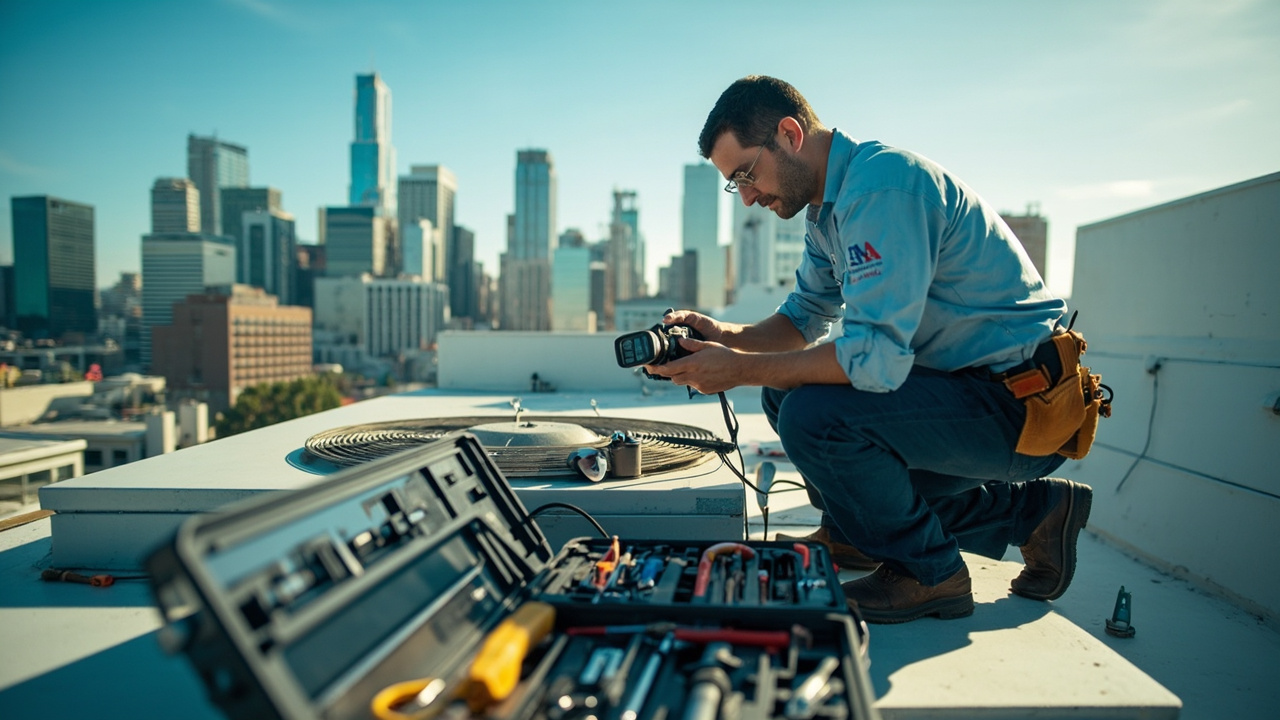
Commercial AC repair requires a different approach than residential service. We do not send a single technician with a standard tool kit. We deploy two-person teams with diagnostic equipment built for industrial-grade systems.

Our process starts with thermal imaging and digital manifold analysis. We identify the failure point without guessing. Compressor short cycling indicates capacitor failure or refrigerant undercharge. Uneven cooling across zones points to damper motor failure or duct leakage. High superheat readings reveal expansion valve problems or refrigerant restrictions.

We carry commercial-grade components on our trucks. Copeland scroll compressors, Sporlan thermostatic expansion valves, and Honeywell control boards for major brands including Carrier, Trane, Lennox, and York. We do not make multiple trips for parts. Time is money in commercial environments.

For multi-zone systems, we test each air handler independently. We verify static pressure, measure supply and return temperatures, and calculate actual versus rated airflow. If your variable air volume boxes are not modulating correctly, we recalibrate or replace actuators on site.

Refrigerant work on commercial systems requires precision. We use electronic scales accurate to 0.1 pounds, not guesswork. California regulations prohibit refrigerant venting, so we recover and recycle all R-410A and R-22 before repairs. We pressure test with nitrogen, pull a proper vacuum to 500 microns, and verify charge by subcooling and superheat measurements.

We document everything. You receive a detailed report showing system performance before and after repair, including amperage draws, temperature differentials, and refrigerant pressures. This documentation matters for your facilities management records and future maintenance planning.

What Happens During Your Commercial AC Service Call

Commercial AC Repair in Los Angeles – Minimize Downtime with Industrial-Grade HVAC Solutions
01

Emergency Dispatch and Diagnostics

You call our dedicated commercial line at (310) 579-0040, and we dispatch a two-person crew immediately. We arrive with commercial diagnostic equipment including thermal cameras, refrigerant analyzers, and digital manometers. The team performs a systematic assessment of your rooftop units, air handlers, and control systems. We identify the root cause, not just the symptom, within the first 30 minutes on site.
02

Component Repair and Testing

We execute the repair using commercial-grade replacement components carried on our service vehicles. Compressor replacements, condenser coil repairs, and control board installations happen on site without delays. Each repair includes system testing under load conditions. We verify amperage, airflow, and temperature split across all zones. Your system must meet manufacturer specifications before we sign off. No shortcuts.
03

Performance Verification and Documentation

Before leaving your facility, we run the system through a complete operational cycle. We test emergency shutdown protocols, verify thermostat communication, and confirm proper refrigerant charge. You receive a detailed service report documenting pre-repair and post-repair performance metrics. This report includes photos, pressure readings, and temperature data. We also provide a recommended maintenance schedule to prevent future failures and extend equipment lifespan.

Why Los Angeles Businesses Choose A Plus HVAC for Commercial Repairs

Commercial HVAC work in Los Angeles requires more than technical skill. It requires understanding how this city operates.

We know the building stock. The post-war commercial buildings along Wilshire Boulevard have original HVAC systems pushing 40 years. The newer Class A offices in Century City run sophisticated building automation systems that require specialized programming knowledge. The industrial warehouses in the South Bay need high-capacity units that can handle 24/7 operation.

We understand Los Angeles Department of Building and Safety requirements. Commercial HVAC work often triggers permit requirements, especially when replacing equipment or modifying refrigerant lines. We handle the permit process and ensure all work meets California Mechanical Code standards. You do not deal with the bureaucracy.

Our technicians hold EPA Universal Certification and NATE commercial certifications. They have logged thousands of hours on package units, split systems, and chiller-based cooling systems. They can troubleshoot legacy pneumatic controls and modern BACnet systems. They speak the language of facilities managers, not homeowners.

Response time matters in commercial environments. We maintain dedicated inventory for commercial jobs. When a compressor fails on your 15-ton Carrier rooftop unit, we do not order parts and return next week. We stock them. We fix it today.

We have worked in every commercial environment Los Angeles offers. Retail spaces in The Grove. Medical offices in Encino. Manufacturing plants in Vernon. Cold storage facilities at the Port. Hotels in Santa Monica. Each environment has unique cooling demands and compliance requirements. We have seen it all.

Your business cannot afford extended downtime. We do not create it.

What to Expect When You Call A Plus HVAC for Commercial Service

Same-Day Emergency Response

Commercial AC failures do not wait for convenient scheduling. We maintain dedicated commercial crews available for same-day dispatch throughout Los Angeles County. When you call (310) 579-0040 before noon, we arrive the same business day. For true emergencies involving health and safety risks or critical operations, we offer after-hours and weekend service. Our average response time for commercial emergencies is under two hours during business hours. We understand that every hour your system is down costs you money in lost productivity, unhappy customers, and potential code violations.

Comprehensive System Assessment

Our diagnostic process goes beyond fixing the immediate problem. We perform a complete system evaluation to identify potential failure points before they cause downtime. This includes amp draw testing on all motors, refrigerant analysis, airflow measurement, and control system verification. You receive a written assessment detailing current system health, recommended repairs prioritized by urgency, and estimated remaining equipment life. This information allows you to budget for replacements and plan maintenance during slow periods rather than experiencing unexpected failures during peak business hours.

Minimal Business Disruption

We structure repairs to minimize impact on your operations. For multi-unit buildings, we work zone by zone to maintain partial cooling during repairs. We coordinate with your facilities team to schedule noisy work during off-hours. Our technicians arrive in unmarked vehicles if discretion matters for your business. We contain work areas, protect finished surfaces, and clean up completely before leaving. Your customers and employees should not know we were there, except that the building is comfortable again. The final result is a system operating at design specifications with documented performance metrics.

Preventive Maintenance Programs

After emergency repairs, we offer customized preventive maintenance agreements designed for your specific equipment and usage patterns. These programs include quarterly inspections, filter changes, coil cleaning, and refrigerant analysis. Scheduled maintenance reduces emergency breakdowns by identifying wear items before they fail. You receive priority scheduling, discounted service rates, and detailed maintenance logs for your facilities records. Our maintenance customers experience 60 percent fewer emergency calls than buildings without regular service. Preventive maintenance also extends equipment life and maintains energy efficiency, reducing operating costs year over year.

Frequently Asked Questions

You Have Questions,
We Have Answers

What is the $5000 AC rule? +

The $5000 AC rule refers to IRS Section 179 and Tangible Property Regulations, which allow businesses to expense HVAC repairs immediately if costs stay under certain thresholds, rather than capitalizing and depreciating them. If your commercial AC repair exceeds $5000 or significantly extends equipment life, you may need to capitalize it. For Los Angeles businesses, this distinction matters during tax planning. Minor repairs like compressor replacements or refrigerant fixes typically qualify as deductible expenses. Major system overhauls or retrofits may trigger capitalization requirements. Consult your CPA to determine how your specific repair qualifies under current tax code.

What are common commercial HVAC problems? +

Los Angeles commercial properties face refrigerant leaks from aging lines, compressor failures due to constant operation, and thermostat malfunctions from outdated controls. Clogged condensate drains cause water damage in multi-story buildings. Dirty evaporator coils reduce efficiency in high-occupancy spaces. Electrical failures from voltage spikes damage contactors and capacitors. Poor airflow stems from blocked filters or duct leaks. Rooftop units common in Los Angeles commercial buildings suffer from weathering and corrosion. Inadequate maintenance accelerates wear on belts and bearings. System imbalances create hot and cold zones that disrupt business operations and tenant comfort.

What are the costs of commercial HVAC repair? +

Commercial HVAC repair costs depend on system size, component failure, and accessibility. Diagnostic fees run $150 to $300. Simple fixes like thermostat replacement or filter changes cost $200 to $500. Compressor replacement ranges from $2000 to $6000. Refrigerant recharges cost $400 to $1500. Los Angeles rooftop unit repairs add labor premiums for crane access or difficult roof access. Emergency after-hours service increases costs by 50 to 100 percent. Multi-zone system repairs cost more than single-zone units. Preventative maintenance contracts reduce emergency repair frequency and control long-term costs for commercial properties.

What is the life expectancy of a commercial AC unit? +

Commercial AC units last 15 to 20 years with proper maintenance. Los Angeles coastal properties see shorter lifespans from salt air corrosion. Rooftop units face UV degradation and temperature extremes that accelerate wear. System runtime hours matter more than calendar age. A restaurant running HVAC 16 hours daily wears components faster than an office operating 8 hours. Neglected maintenance cuts lifespan by 30 to 40 percent. Quality installation extends longevity. Undersized units overwork and fail early. Regular coil cleaning, refrigerant checks, and electrical testing maximize your investment and delay costly replacement decisions.

What is the 3 minute rule for AC? +

The 3 minute rule protects your compressor from short cycling damage. After your AC shuts off, wait 3 minutes before restarting. This allows refrigerant pressure to equalize between the high and low sides of the system. Immediate restarts force the compressor to start against high pressure, which strains the motor and shortens its life. Commercial buildings with building automation systems should program minimum off-cycle delays. Los Angeles properties with frequent power fluctuations or manual overrides need this protection. Violating this rule causes compressor burnout, capacitor failure, and unexpected downtime that disrupts business operations.

Can I write off my new AC unit on my taxes? +

Yes, commercial property owners can deduct AC replacement through Section 179 expensing or bonus depreciation. You may write off the full cost in the installation year if it qualifies under current limits. Alternatively, depreciate over the modified accelerated cost recovery system period, typically 39 years for commercial building systems. Energy-efficient upgrades may qualify for additional tax credits under federal programs. Los Angeles businesses benefit from California energy incentives that offset replacement costs. Repairs qualify as immediate deductions. Consult your tax advisor to maximize deductions and comply with IRS tangible property regulations for your specific situation.

What is the 2 foot rule for HVAC? +

The 2 foot rule requires maintaining 2 feet of clearance around outdoor condenser units and rooftop equipment. This spacing allows proper airflow for heat exchange and technician access for maintenance. Los Angeles commercial properties often violate this rule with stored equipment, landscaping, or HVAC equipment clustered too tightly on crowded rooftops. Blocked airflow reduces efficiency by 20 to 30 percent and causes premature compressor failure. Debris accumulation damages coils. Building code inspections flag clearance violations. Ensure vendors, landscapers, and maintenance staff understand this requirement to protect system performance and avoid costly repairs from restricted airflow.

What is the most common part to fail on an AC unit? +

Capacitors fail most frequently in commercial AC units. These components start the compressor and fan motors but degrade from heat, voltage spikes, and age. Los Angeles properties experience capacitor failure from temperature extremes on rooftop installations. A failed capacitor prevents system startup or causes hard starting that damages the compressor. Replacement costs $150 to $400. Contactors fail second most often from electrical arcing and frequent cycling. Thermostats malfunction from user error or wiring issues. Regular inspections catch capacitor bulging or leaking before complete failure. Preventative replacement during routine maintenance prevents emergency downtime and business disruption.

How often should a commercial HVAC system be serviced? +

Commercial HVAC systems require quarterly maintenance minimum, with monthly service recommended for high-use facilities like restaurants or data centers. Los Angeles properties need biannual coil cleaning due to dust and smog particulates. Filter changes occur monthly or quarterly depending on occupancy and air quality. Annual refrigerant checks prevent leaks. Seasonal inspections before summer cooling demand catch problems early. Rooftop units need drainage checks after winter rains. Maintenance contracts ensure compliance with manufacturer warranty requirements and reduce emergency repair costs by 30 to 40 percent. Document all service for insurance claims, tenant disputes, and code compliance.

Will insurance cover HVAC repair? +

Commercial property insurance covers HVAC repair if failure results from covered perils like fire, vandalism, or storm damage. Standard policies exclude wear and tear, neglect, or age-related breakdowns. Equipment breakdown coverage adds protection for mechanical failure from power surges or internal malfunctions. Los Angeles businesses should verify coverage limits and deductibles. Some policies require proof of regular maintenance to honor claims. Business interruption insurance covers revenue loss from HVAC failure during summer heat. Review your policy annually. Document all maintenance and repairs. Insurers deny claims lacking maintenance records or when failure stems from deferred upkeep.

How Los Angeles Climate and Building Codes Impact Commercial HVAC Reliability

Los Angeles presents unique challenges for commercial air conditioning systems. The combination of high summer temperatures, poor air quality, and dense urban development creates extreme operating conditions. Rooftop units in Downtown and Mid-Wilshire face constant exposure to particulate pollution that clogs condenser coils and reduces efficiency. The marine layer in coastal areas introduces salt air that corrodes copper refrigerant lines and aluminum fins. Buildings in the San Fernando Valley experience temperature swings from 50 degrees at night to 105 degrees during the day, cycling compressors far more frequently than moderate climates. California Title 24 energy standards require commercial buildings to maintain strict efficiency metrics, meaning aging systems face both performance problems and compliance risk simultaneously.

A Plus HVAC Los Angeles maintains deep expertise in local building requirements and climate-specific system design. We understand Los Angeles Department of Building and Safety permit requirements for commercial HVAC work. We know which repairs trigger permit obligations and how to navigate the approval process efficiently. Our technicians understand the specific failure patterns common to Los Angeles buildings, from refrigerant leaks caused by seismic movement to control board failures from voltage fluctuations during heat waves. This local knowledge translates to faster diagnosis, correct repairs the first time, and systems optimized for Los Angeles operating conditions rather than generic manufacturer specifications.
HVAC Services in The Los Angeles Area

Want to know if we service your neighborhood? Use the map below to see our local coverage. A Plus proudly serves Los Angeles and nearby communities with fast response times and top-tier HVAC expertise. Whether you're downtown or in the suburbs, we're just a call away. Our mobile team is equipped to reach you quickly and solve your HVAC issues efficiently. Don’t hesitate to reach out—comfort and reliability are closer than you think.

Address:
A Plus HVAC Los Angeles, 1901 Ave of the Stars, Los Angeles, CA, 90067

Additional Services We Offer

Our news updates

Latest Articles & News from The Blogs

Sherman Oaks homeowners face a unique set of cooling challenges. The location between the Santa Monica Mountains and the flatlands…

Full AC Replacement Costs for Sherman Oaks Homeowners

Sherman Oaks homeowners face a unique set of cooling challenges. The location between the Santa Monica Mountains and the flatlands…

Switching From Gas to Electric Heating in Miracle Mile (And What It Costs)

Switching From Gas to Electric Heating in Miracle Mile (And What It Costs) Miracle Mile homeowners are moving toward all…

HVAC Strategies for Quiet Home Recording Studios in Toluca Lake

Precision HVAC Solutions for Los Angeles Recording StudiosHome studio owners in Toluca Lake face a unique set of challenges when…

Contact Us

Your business cannot afford prolonged downtime. Call A Plus HVAC Los Angeles now at (310) 579-0040 for same-day commercial AC repair. Our commercial service teams are standing by with the equipment, parts, and expertise to restore your cooling system fast.